Academic year 2026–2027. Read the full document below, or download the original PDF.
ISE Mission Statement
Original Mission Statement – Submitted for Authorization in 2021
The International School of Egypt (ISE) is a co-educational, multinational, college preparatory school that provides an experience with an international education and rigorous assessment. ISE is dedicated to educational excellence and committed to developing in each student a love of learning and the discipline necessary to become contributing, ethical citizen through intercultural understanding, respect and collaboration.
2026 Reviewed Mission Statement
The International School of Egypt (ISE) continues to affirm its commitment to being a co- educational, multinational, college preparatory school providing an international education founded on educational excellence, rigorous assessment, intercultural understanding, respect, collaboration, and responsible citizenship.
ISE Vision Statement
Original Vision Statement – Submitted for Authorization in 2021
The International School of Egypt strives to create an atmosphere where students will grow to be creative, curious, caring, knowledgeable and contributing members of a global community.
2026 Reviewed Vision Statement
The International School of Egypt strives to create an inclusive and internationally minded learning environment in which students grow as creative, curious, caring, knowledgeable, and contributing members of a global community .
IB Mission Statement
The International Baccalaureate aims to develop inquiring, knowledgeable and caring young people who help to create a better and more peaceful world through intercultural understanding and respect.
IB Vision Statement
The International Baccalaureate’s vision is to create a better and more peaceful world through high-quality international education, developing students who are inquiring, knowledgeable, caring, active, compassionate and lifelong learners who understand that other people, with their differences, can also be right.
The IB Learner Profile
The IB learner profile represents 10 attributes valued by IB World Schools. We strongly believe that these attributes help students become responsible members of the world.
Inquirers: They develop their natural curiosity. They acquire the skills necessary to conduct inquiry and research and show independence in learning. They actively enjoy learning, and this love of learning will be sustained throughout their lives.
Knowledgeable They explore concepts, ideas and issues that have local and global significance. In so doing, they acquire in-depth knowledge and develop understanding across a broad and balanced range of disciplines.
Thinkers: They exercise initiative in applying thinking skills critically and creatively to recognize and approach complex problems, and make reasoned, ethical decisions.
Communicators: They understand and express ideas and information confidently and creatively in more than one language and in a variety of modes of communication. They work effectively and willingly in collaboration with others.
Principled: They act with integrity and honesty, with a strong sense of fairness, justice, and respect for the dignity of the individual, groups, and communities. They take responsibility for their own actions and the consequences that accompany them.
Open-minded: They understand and appreciate their own cultures and personal histories, and are open to the perspectives, values and traditions of other individuals and communities. They are accustomed to seeking and evaluating a range of points of view and are willing to grow from the experience.
Risk-takers: They approach unfamiliar situations and uncertainty with courage and forethought and have the independence of spirit to explore new roles, ideas, and strategies. They are brave and articulate in defending their beliefs.
Balanced: They understand the importance of intellectual, physical, and emotional balance to achieve personal well-being for themselves and others.
Reflective: They consider their own learning and experience. They can assess and understand their strengths and limitations to support their learning and personal development.
What is the Diploma Programme?
The IB Diploma Programme (DP) is an academically challenging and balanced programme of education that prepares students, aged 16 to 19, for success at university and their life. It has been created to develop the intellectual, social, emotional, and physical skills of students. The IB Diploma Programme is recognized by the world’s leading universities.
IB DP students will:
- Develop intellectual, physical, and emotional skills
- Acquire the new knowledge and understand the connections between different areas of life studying courses from 6 subject groups.
- Acquire the learning skills that will prepare them for college
- Study at least two languages that help them understand different cultures.
- Make connections across different subjects through the Theory of Knowledge course. Theory of knowledge is a course on critical thinking that makes connections across the academic disciplines and explores the nature of knowledge.
- Undertake research into an area of interest through the extended essay. The extended essay is an in-depth, externally assessed, independent research project into a topic of the student’s choice. Up to 4,000 words in length, it promotes high-level research and writing skills, intellectual discovery, and creativity.
- Express their personal and interpersonal interest through creativity, activity, and service. CAS encourages engagement in the arts, creative thinking, a healthy lifestyle, and a sense of social responsibility.
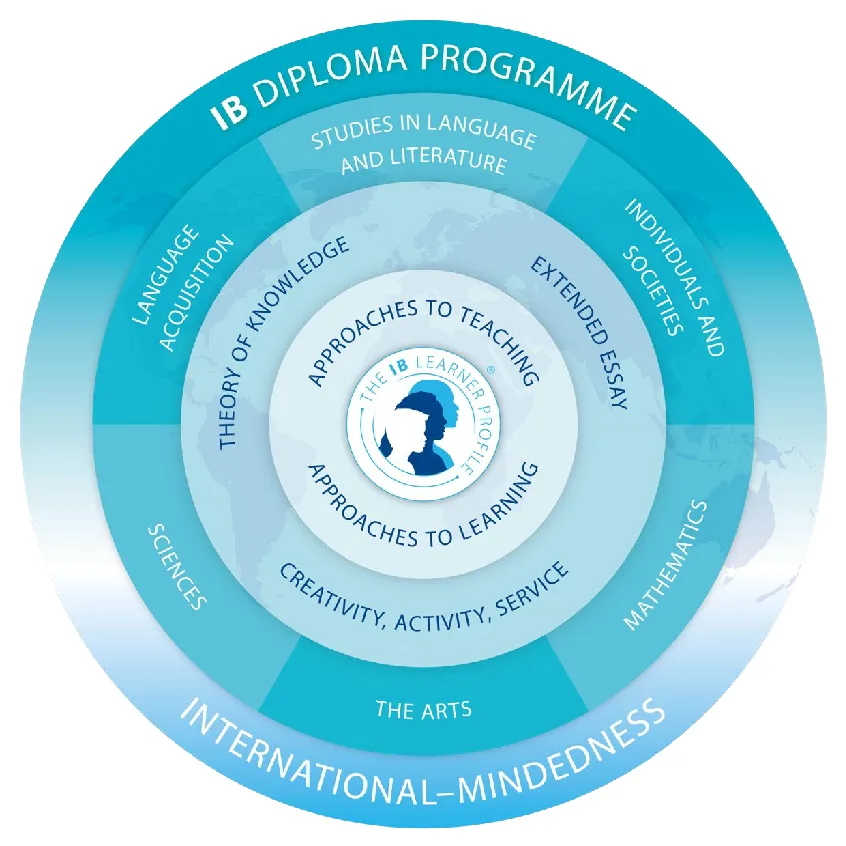
IB DP contains six subject groups together with the DP core:
- Creativity, activity, service (CAS)
- The extended essay (EE).
- Theory of knowledge (TOK).
This is illustrated by the Diploma Programme model below.
Choosing Subjects for a Diploma
Subject groups
Group 1: Studies in Languages and Literature
- English Language and Literature A
Group 2: Language acquisition
- Arabic B
Group 3: Individuals and Societies
- Economics
- Business Management
Group 4: Sciences
- Biology
- Chemistry
- Physics
Group 5: Mathematics
- Analysis and Approaches
Group 6: Arts
- Visual Arts
Selecting subjects from groups 1 to 6
When selecting subjects for a diploma:
- At least three and not more than four subjects must be selected at higher level (HL) and the others at standard level (SL).
- One subject must be selected from each of groups 1 to 5.
- The sixth subject must be selected from group 6 or from groups 3 or 4.
- Instead of a group 6 subject a candidate may offer an additional subject chosen from groups 3 or 4.
No candidate may count towards the diploma:
- The same subject twice, regardless of whether higher level or standard level.
- The same language for group 1 and group 2
Subjects Groups
Group 1: Studies in Language and Literature
English A: Language and Literature (SL/HL)
Course description:
The language A Literature course introduces students to the analysis of literary texts. It is the course through which the IB’s policy of mother-tongue entitlement is delivered.
The course is organised into three areas of exploration and seven central concepts and focuses on the study of literary works. Together, the three areas of exploration of the course add up to a comprehensive exploration of literature from a variety of cultures, literary forms, and periods. Students learn to appreciate the artistry of literature and develop the ability to reflect critically on their reading, presenting literary analysis powerfully through both oral and written communication.
Assessment
| Standard Level | High Level |
|---|---|
| External Assessment 70% | External Assessment 80% |
| Paper 1: Textual analysis (1 hour 15 minutes) The paper consists of two unseen texts. Students write an analysis of one of these texts. (20 marks) 35% | Paper 1: Comparative textual analysis (2 hours 15 minutes) The paper consists of two pairs of unseen texts. Students write a comparative analysis of one pair of texts. (40 marks) 35% |
| Paper 2: Essay (1 hour 45 minutes) In response to one of six questions students write an essay based on both the literary texts studied in part 3. The questions are the same at HL but the assessment criteria are different. (30 marks) 35% | Paper 2: Essay (1 hour 45 minutes) In response to one of six questions students write an essay based on at least two of the literary texts studied in part 3. The questions are the same at SL, but the assessment criteria are different. (30 marks) 25% |
| HL essay: Students submit an essay on one non- literary text or a collection of non-literary texts by one same author, or a literary text or work studied during the course. 1200 – 1500 words (20 marks) 20% | |
| Internal Assessment 30 % | Internal Assessment 20 % |
| Individual oral commentary: (15 mins) Students comment on an extract from a literary text studied in part 4 of the course. Students are given two guiding questions. (40 marks) 30% | Individual oral commentary: (15 mins) Students comment on an extract from a literary text studied in part 4 of the course. Students are given two guiding questions. (40 marks) 20% |
Group 2: Language Acquisition
Arabic B (SL/HL)
Course Description
Students must study at least one subject from group 2.
The main emphasis of Arabic B is on the acquisition and use of language in a range of contexts and for different purposes while, at the same time, promoting an understanding of another culture through the study of its language.
Arabic Language B is a two-year course for students with some background in Arabic Language. Arabic B Syllabus focuses on the learning of language through meaning. By the end of the course, students are able to communicate in the language through the study of language, themes, and texts. They understand how language works and acquire receptive, productive, and interactive skills across a range of contexts.
Arabic B syllabus is organised into five prescribed themes: identities, experiences, human ingenuity, social organisation and sharing the planet.
Assessment
| External Assessment 75% | External Assessment 75% |
|---|---|
| Paper 1 Writing 1 hr 15 min Producing a text based on a choice of specific text types (e.g., article, speech, letter, flyer) of 250-400 words length. 25 % | Paper 1 Writing 1 hr 30 min Producing a text based on a choice of specific text types (e.g., article, speech, letter, flyer) of 4 5 0 – 6 0 0 w ords length. 25% |
| Paper 2 Receptive skills – listening and reading (separate sections) Listening comp. – 45 min Reading comp. – 1 hr 50% | Paper 2 Receptive skills – listening and reading (separate sections) Listening comp. – 1 hr Reading comp. – 1 hr 50% |
| Internal Assessment 25 % | Internal Assessment 25 % |
| Internal Assessment Individual oral 12-15 min + 15 min of preparation 25% | Internal Assessment Individual oral 12-15 min + 20 min of preparation for HL, this is based on an extract of one of the two literary works studied during the course 25% |
Group 3 – Individuals and Societies
Business Management
Course Description
The business management course is designed to develop students’ knowledge and understanding of business management theories, as well as their ability to apply a range of tools and techniques. Students learn to analyse, discuss, and evaluate business activities at local, national, and international levels. The course covers a range of organisations from all sectors, as well as the socio-cultural and economic contexts in which those organisations operate.
Assessment
| Standard Level | High Level |
|---|---|
| External Assessment 70% | External Assessment 80% |
| Paper 1: (1 hour and 30 mins)- [35%] Based on a pre-released statement that specifies the context and background for the unseen case study (30 marks) Section A: Students answer all structured questions in this section based on the case study (20 marks) Section B: Students answer one out of two extended response questions based on the case study (10 marks) | Paper 1 (1 hour and 30 minutes)- [25%] Based on a pre-released statement that specifies the context and background for the unseen case study (30 marks) Section A: Students answer all structured questions in this section based on the case study (20 marks) Section B: Students answer one out of two extended response questions based on the case study (10 marks) |
| Paper 2: (1 hour &30 minutes) – [35%] Based on unseen stimulus material (40 marks) Section A: Students answer all structured questions in this section based on the unseen stimulus material (20 marks) Section B: Students answer one out of two questions comprised of some structured questions and an extended response question based on the unseen stimulus material (20 marks) | Paper 2 (1 hour and 45 minutes) – [30%] Based on the unseen stimulus material (50 marks) Section A Students answer all structured questions in this section based on the unseen stimulus material (30 marks) Section B Students answer one out of two questions comprised of some structured questions and an extended response question based on the unseen stimulus material (20 marks) Paper 3 (1 hour and 15 minutes) – (25%) Based on unseen stimulus material about a social enterprise (25 marks) Students answer one compulsory question based on the unseen stimulus material. |
| Internal Assessment 30% | Internal Assessment 20% |
| Business research project Students produce a research project about a real business issue or problem facing a particular organisation using a conceptual lens. Maximum 1,800 words. (25 marks) | Business research project Students produce a research project about a real business issue or problem facing a particular organisation using a conceptual lens. Maximum 1,800 words. (25 marks) |
Economics
Course description
Economics is an exciting, dynamic subject that allows students to develop an understanding of the complexities and interdependence of economic activities in a rapidly changing world. At the heart of economic theory is the problem of scarcity. While the world’s population has unlimited needs and wants, there are limited resources to satisfy these needs and wants. As a result of this scarcity, choices must be made. The DP economics course, at both SL and HL, uses economic theories to examine the ways in which these choices are made:
- At the level of producers and consumers in individual markets (microeconomics)
- At the level of the government and the national economy (macroeconomics)
- At an international level where countries are becoming increasingly interdependent through international trade and the movement of labour and capital (the global economy).
| Standard Level | High Level |
|---|---|
| External Assessment 80% | External Assessment 80% |
| Paper 1: Extended Response (1 hour and 30 minutes) An extended response paper (50 marks) Section A/ Syllabus content: section 1— microeconomics. Students answer one question from a choice of two. (25 marks) Section B/ Syllabus content: | Paper 1: Case Study Paper 1 (1 hour and 30 minutes) An extended response paper (50 marks) Section A Syllabus content: section 1—microeconomics. Students answer one question from a choice of two. (25 marks) Section B Syllabus content: |
| section 2— macroeconomics. Students answer one question from a choice of two. (25 marks) 40 % | section 2— macroeconomics. Students answer one question from a choice of two. (25 marks) 30 % |
| Paper 2: Data Response (1 hour and 30 min) (40 marks) Section A /Syllabus content: section 3—international economics. Students answer one question from a choice of two. (20 marks) Section B /Syllabus content: section 4— development economics. Students answer one question from a choice of two. (20 marks) 40 % | Paper 2: Course topics Section A /Syllabus content: section 3— international economics. Students answer one question from a choice of two. (20 marks) Section B/ Syllabus content: section 4— development economics. Students answer one question from a choice of two. (20 marks) 30 % |
| Paper 3: HL Extension paper Sections 1 to 4—microeconomics, macroeconomics, international economics, development economics Students answer two questions from a choice of three. (25 marks per questions) 20 % | |
| Internal Assessment 20 % | Internal Assessment 20 % |
| Student Portfolio: Consists of three commentaries, based on different sections of the syllabus and on published extracts from the news media. Maximum 750 words x 3 (45 marks) | Student Portfolio: Consists of three commentaries, based on different sections of the syllabus and on published extracts from the news media. Maximum 750 words x 3 (45 marks) |
Group 4: Sciences Biology
Course description
During the Biology course students should become aware of how scientists work and communicate with each other. Students have opportunities to design investigations, collect data, develop manipulative skills, analyse results, collaborate with peers, and evaluate and communicate their findings. The investigations may be laboratory based or they may make use of simulations and data bases.
Assessment
| Standard Level | High Level |
|---|---|
| External Assessment 80% | External Assessment 80% |
| Paper 1: Multiple-choice questions 36% | Paper 1: Multiple -choice questions 36% |
| Paper 2: Data –based questions 44% | Paper 2: Data –based questions 44% |
| Internal Practical Assessment 20% | Internal Practical Assessment 20% |
| Collaborative science project. The Group 4 Project is compulsory for all group 4 students and takes place at the end of the academic year in IB1. Completion of this component is obligatory; failure to complete this component of the course will result in an automatic failure of the group 4 subject, and consequently, the IB Diploma or DP course. |
Chemistry Chemistry is an experimental science that combines academic study with the acquisition of practical and investigational skills.
It is often called the central science as chemical principles underpin both the physical environment in which we live and all biological systems. Apart from being a subject worthy of study, chemistry is often a prerequisite for many other courses in higher education, such as medicine, biological science, and environmental science.
Students develop the skills to work independently on their own design, but also collegiately, including collaboration with schools in different regions, to mirror the way in which scientific research is conducted in the wider community.
Assessment
| Standard Level | High Level |
|---|---|
| External Assessment 80% | External Assessment 80% |
| Paper 1: 36% 1 hour and a half 1A multiple choice 1B data based questions 55 marks | Paper 1: 36% 2 hours test 1A multiple choice 1B data based questions 75 marks |
| Paper 2: 44% 1 hours and a half Short answers and extended 50 marks | Paper 2: Data –based questions 44% 2 hours and a half test Short answers and extended 90 marks |
| Internal Practical Assessment 20% 24 marks | Internal Practical Assessment 20% |
| Collaborative science project. The Group 4 Project is compulsory for all group 4 students and takes place at the end of the academic year in IB1. Completion of this component is obligatory; failure to complete this component of the course will result in an automatic failure of the group 4 subject, and consequently, the IB Diploma or DP course. |
Physics
Physics is the most fundamental of the experimental sciences, as it seeks to explain the universe itself from the very smallest particles to the vast distances between galaxies.
Despite the exciting and extraordinary development of ideas throughout the history of physics, observations remain essential to the very core of the subject. Models are developed to try to understand observations, and these themselves can become theories that attempt to explain the observations.
Assessment
| Standard Level | High Level |
|---|---|
| External Assessment 80% | External Assessment 80% |
| Paper 1: Multiple-choice Questions 20% | Paper 1: Multiple -choice Questions 20% |
| Paper 2: Data –based question 40% | Paper 2: Data –based question 36% |
| Paper 3: short-answer questions 20 % | Paper 3: short-answer questions 24 % |
| Internal Practical Assessment 20% | Internal Practical Assessment 20% |
| Group 4 Project The Group 4 Project is compulsory for all group 4 students and takes place at the end of the academic year in IB1. Completion of this component is obligatory; failure to complete this component of the course will result in an automatic failure of the group 4 subject, and consequently, the IB Diploma or DP course. |
Group 5 – Mathematics: Analysis and Approaches SL/HL
Analysis and Approaches is a course for students who enjoy studying mathematics, investigate and create new mathematical arguments and develop mathematical thinking. Students will be able to explore different applications of these mathematical knowledge and ideas. Analysis and approaches include calculus, algebraic, graphical, and numerical approaches. This subject is suitable for students who will go on to study undergraduate courses with substantial mathematics content.
Assessment
| Standard Level | High Level |
|---|---|
| External assessment 80% | External assessment 80% |
| Paper 1 (1.5 hours) No calculators allowed. Section A: compulsory short-response questions based on the syllabus. Section B: compulsory extended-response questions based on the syllabus. 40% | Paper 1 (2 hours) No calculators allowed. Section A: compulsory short-response questions based on the syllabus. Section B: compulsory extended-response questions based on the syllabus. 30% |
| Paper 2 (1.5 hours) Calculators are allowed Section A: compulsory short-response questions based on the syllabus. Section B: compulsory extended-response questions based on the syllabus. 40% | Paper 2 (2 hours) Calculators are allowed Section A: compulsory short-response questions based on the syllabus. Section B: compulsory extended-response questions based on the syllabus. 30% |
| Paper 3 (1 hour) Calculators are allowed Two compulsory extended response problem-solving questions. 20% | |
| Internal practical assessment 20% | Internal practical assessment 20% |
Group 6 – Visual Arts
The visual arts are an integral part of everyday life, permeating all levels of human creativity, expression, communication and understanding.
The IB Diploma Programme visual arts course encourages students to challenge their own creative and cultural expectations and boundaries. It is a thought-provoking course in which students develop analytical skills in problem-solving and divergent thinking, while working towards technical proficiency and confidence as art-makers. In addition to exploring and comparing visual arts from different perspectives and in different contexts, students are expected to engage in, experiment with and critically reflect upon a wide range of contemporary practices and media. The course is designed for students who want to go on to study visual arts in higher education as well as for those who are seeking lifelong enrichment through visual arts.
Supporting the International Baccalaureate mission statement and learner profile, the course encourages students to actively explore the visual arts within and across a variety of local, regional, national, international, and intercultural contexts. Through inquiry, investigation, reflection and creative application, visual arts students develop an appreciation for the expressive and aesthetic diversity in the world around them, becoming critically informed makers and consumers of visual culture.
Assessment
| Standard Level | High Level |
|---|---|
| Part 1: Comparative study 20% Students at SL analyse and compare different artworks by different artists. This independent critical and contextual investigation explores artworks, objects, and artefacts from differing cultural contexts. • SL students submit 10–15 screens which | Part 1: Comparative study 20% Students at HL analyse and compare different artworks by different artists. This independent critical and contextual investigation explores artworks, objects and artefacts from differing cultural contexts. • HL students submit 10–15 screens which examine and |
| examine and compare at least three artworks, at least two of which should be by different artists. The work selected for comparison and analysis should come from contrasting contexts (local, national, international and/or intercultural). • SL students submit a list of sources used. | compare at least three artworks, at least two of which need to be by different artists. The works selected for comparison and analysis should come from contrasting contexts (local, national, international and/or intercultural). • HL students submit 3–5 screens which analyse the extent to which their work and practices have been influenced by the art and artists examined. • HL students submit a list of sources used. |
| Part 2: Process portfolio 40% Students at SL submit carefully selected materials which evidence their experimentation, exploration, manipulation, and refinement of a variety of visual arts activities during the two- year course. • SL students submit 9–18 screens which evidence their sustained experimentation, exploration, manipulation, and refinement of a variety of art-making activities. For SL students the submitted work must be in at least two artmaking forms, each from separate columns of the art-making forms table. | Part 2: Process portfolio 40% Students at HL submit carefully selected materials which evidence their experimentation, exploration, manipulation, and refinement of a variety of visual arts activities during the two-year course. • HL students submit 13–25 screens which evidence their sustained experimentation, exploration, manipulation, and refinement of a variety of art-making activities. For HL students the submitted work must have been created in at least three art-making forms, selected from a minimum of two columns of the art-making forms table. |
| Part 3: Exhibition 40% Students at SL submit for assessment a selection of resolved artworks from their exhibition. The selected pieces should show evidence of their technical accomplishment during the visual arts course and an understanding of the use of materials, ideas, | Part 3: Exhibition 40% Students at HL submit for assessment a selection of resolved artworks from their exhibition. The selected pieces should show evidence of their technical accomplishment during the visual arts course and an understanding of the use of materials, ideas, and |
| and practices appropriate to visual communication. • SL students submit a curatorial rationale that does not exceed 400 words. • SL students submit 4–7 artworks. • SL students submit exhibition text (stating the title, medium, size and intention) for each selected artwork. SL students may submit two photographs of their overall exhibition. These exhibition photographs provide an understanding of the context of the exhibition and the size and scope of the works. While the photographs will not be used to assess individual artworks, they may give the moderator insight into how a candidate has considered the overall experience of the viewer in their exhibition | practices appropriate to visual communication. • HL students submit a curatorial rationale that does not exceed 700 words. • HL students submit 8–11 artworks. • HL students submit exhibition text (stating the title, medium, size and intention) for each selected artwork. HL students may submit two photographs of their overall exhibition. These exhibition photographs provide an understanding of the context of the exhibition and the size and scope of the works. While the photographs will not be used to assess individual artworks, they may give the moderator insight into how a candidate has considered the overall experience of the viewer in their exhibition. |
The International School of Egypt is offering the online DP Pamoja courses. These courses will be delivered via an online platform “Pamoja Provider of IB DP Courses” and is limited to a maximum enrolment level of five students. These students will work under the guidance of an onsite coordinator (SBC) who will monitor student progress as they work in the Pamoja Education online environment. Only highly motivated students with high effort scores will be permitted to enrol in this course. Please note that there will be a non- refundable fee policy associated with the delivery of the online courses. Dropping the course will not result in any refund of the course fees paid to Pamoja Education. Only selected students will be able to complete these online offerings.
Please see the IB DPC for more information on registration for an online course.
Assessment
At the end of the Diploma Programme students are supposed to take external exams that are marked by external IB examiners. Students are required to take internal assessments that are marked by ISE teachers and moderated externally by IB. Exams are in May and results are released in July.
The marks awarded for each course range from 1 (lowest) to 7 (highest). Up to three additional points are added for their combined results on theory of knowledge and the extended essay. The core’s extended essay and TOK are each marked on an A (highest) to E (lowest) scale. CAS is not marked, but completion is required to earn the diploma.
The diploma is awarded to students who gain at least 24 points, subject to certain minimum levels of performance across the whole programme and to satisfactory participation in the creativity, action, and service requirement.
The highest score that can be awarded is 45 points: 6 courses × 7 points, plus 3 points for the core.
Assessment is criterion-related and student performance is measured against the criteria of each subject curriculum. Student performance is not assessed against the performance of other IB DP students.
Diploma Programme course results are awarded to students who take individual DP courses (for example, Chemistry HL or Business Management SL) but do not enrol in the full DP. A student may take as many or as few DP courses as their school allows. Students earn course results (1 to 7) for each course taken.
The Diploma Programme Core
The core of the curriculum model consists of three elements.
Theory of Knowledge (TOK)
Theory of knowledge (TOK) plays a special role in the International Baccalaureate Diploma Programme by providing an opportunity for students to reflect on the nature of knowledge, and on how we know what we claim to know. It is one of the components of the DP core and is mandatory for all students. The TOK requirement is central to the educational philosophy of the DP.
How is TOK structured?
As a thoughtful and purposeful inquiry into different ways of knowing, and into different kinds of knowledge, TOK is composed almost entirely of questions. The most central of these is “How do we know?”, while other questions include:
- What counts as evidence for X?
- How do we judge which is the best model of Y?
- What does theory Z mean in the real world?
Through discussions of these and other questions, students gain greater awareness of their personal and ideological assumptions, as well as developing an appreciation of the diversity and richness of cultural perspectives.
Assessment of TOK
There are two assessment tasks in the TOK course.
- The TOK exhibition (10 marks- ⅓ of the total grade= 33%) assesses the ability of the
student to show how TOK manifests in the world around us. The exhibition is an internal assessment component; it is marked by the teacher and is externally moderated by the IB. The TOK exhibition task has been explicitly designed to be completed during the first year of the DP.
For this task, students are required to create an exhibition of three objects that connect to one of the 35 “IA prompts”. Students must select just one IA prompt on which to base their exhibition, and all three objects must be linked to the same IA prompt. Students are required to create an exhibition comprising three objects, or images of objects, and an accompanying written commentary on each object. To enable their exhibition to be marked by their TOK teacher and for samples of student work to be submitted to the IB for moderation, students are required to produce a single file containing:
- A title clearly indicating their selected IA prompt
- Images of their three objects
- A typed commentary on each object that identifies each object and its specific real-world
context, justifies its inclusion in the exhibition and links to the IA prompt (maximum 950 words)
- Appropriate citations and references.
Each student must create an individual exhibition. Group work may not be undertaken by students. Multiple students in the same TOK class are permitted to create exhibitions on the same IA prompt. However, students in the same class are not permitted to use any of the same objects.
- The TOK essay (10 marks= ⅔= 67% of the total grade) engages students in a more formal
and sustained piece of writing in response to a title focused on the areas of knowledge. The essay is an external assessment component; it is marked by IB examiners. The essay must be a maximum of 1,600 words and must be on one of the six prescribed titles issued by the IB for each examination session.
What is the significance of TOK?
TOK aims to make students aware of the interpretative nature of knowledge, including personal ideological biases – whether these biases are retained, revised, or rejected. It offers students and their teachers the opportunity to:
- Reflect critically on diverse ways of knowing and on areas of knowledge
- Consider the role and nature of knowledge in their own culture, in the cultures of others and in the wider world.
In addition, TOK prompts students to:
- Be aware of themselves as thinkers, encouraging them to become more acquainted with the complexity of knowledge
- Recognize the need to act responsibly in an increasingly interconnected but uncertain world.
TOK also provides coherence for the student, by linking academic subject areas as well as transcending them. It therefore demonstrates the ways in which the student can apply their knowledge with greater awareness and credibility.
Creativity, Activity, Service (CAS)
Creativity, activity, service (CAS) is one of the three essential elements that every student must complete as part of the Diploma Programme. Studied throughout the Diploma Programme, CAS involves students in a range of activities alongside their academic studies. It is not formally assessed. However, students reflect on their CAS experiences as part of the DP and provide evidence of achieving the seven learning outcomes for CAS.
How is CAS structured?
The three strands of CAS, which are often interwoven with activities, are characterised as follows:
- Creativity – arts, and other experiences that involve creative thinking.
- Activity – physical exertion contributing to a healthy lifestyle, complementing academic work elsewhere in the DP.
- Service – an unpaid and voluntary exchange that has a learning benefit for the student. The rights, dignity, and autonomy of all those involved are respected.
In order to demonstrate these concepts, students are required to undertake a CAS project. The project challenges students to:
- Show initiative
- Demonstrate perseverance
- Develop skills such as collaboration, problem solving and decision making.
What is the significance of CAS?
CAS enables students to enhance their personal and interpersonal development by learning through experience. It provides opportunities for self-determination and collaboration with others, fostering a sense of accomplishment and enjoyment from their work.
At the same time, CAS is an important counterbalance to the academic pressures of the DP. The CAS programme formally begins at the start of the Diploma Programme and continues regularly, ideally on a weekly basis, for at least 18 months with a reasonable balance between creativity, activity, and service. All CAS students are expected to maintain and complete a CAS portfolio as evidence of their engagement with CAS. The CAS portfolio is a collection of evidence that showcases CAS experiences and for student reflections; it is not formally assessed. Completion of CAS is based on student achievement of the seven CAS learning outcomes. Through their CAS portfolio, students provide the school with evidence demonstrating achievement of each learning outcome. Students engage in CAS experiences involving one or more of the three CAS strands. A CAS experience can be a single event or may be an extended series of events.
Extended Essay
Nature of the Extended Essay
In brief, the Extended Essay is:
- The major example of a piece of work where the students have the opportunity to show
knowledge, understanding and enthusiasm about a topic of their own choice.
- A piece of formally structured, independent writing about a topic chosen by the student in
conjunction with a supervisor in the school. a piece of writing that enables students to pursue in-depth independent research on a focused topic.
- Chosen from the list of approved DP subjects.
- An essay containing up to 4,000 words, accompanied by a reflection form (RPPF) of maximum
500 words. Moreover, the Extended Essay is:
- Mandatory for all Diploma Programme students
- The outcome of 40-45 hours of work by the student.
- Externally assessed in accordance with 5 criteria and, together with the TOK grade, contributes up to three additional points towards the total score for the IB diploma.
- Awarded a grade ranging from A to E, A being excellent, while E is considered to be a failing condition for the IB Diploma Programme.
Subjects and Topics
Students may write an Extended Essay in all subjects offered within the IBDP at ISE. However, it is highly recommended that students should choose a subject you are enrolled in. The subjects available are: Group 1: Language A: English Literature Group 2: Language B: Arabic Group 3: Economics, Business Management Group 4: Chemistry, Physics, Biology Group 5: Mathematics: Analysis and Approaches Group 6: Visual arts
Roles and Responsibilities
Your responsibilities
- Choose a subject from the available EE subject list.
- Decide on a research question.
- Ensure that the starting point for your essay is a subject that is available.
- Carefully reflect on the reasons for your choice of subject.
- Conduct the research.
- Meet all internal deadlines.
- Familiarise yourself with the necessary requirements and criteria.
- Attend three mandatory reflection sessions.
- Record your formal reflection statements, 500 words in total, on your Reflections on Progress and Planning Form (RPPF)
- Check and proofread the final version of their extended essay.
- Acknowledge all your resources.
Your supervisor
Your supervisor will presumably be a teacher in the subject in which you decided to write the essay. One of the IB requirements is that one of the teachers in your school is your supervisor. Another condition is that the teacher is not related to you, meaning that your parents or private tutors cannot be your supervisors. To sum things up, the supervisor of your choice should:
- Be familiar with the subject-specific requirements and the assessment criteria
- Provide advice and necessary guidance on your research question and methodology
- Meet with you at least 3 times (Reflections on Progress and Planning Form sessions), if not more (the so-called ‘check-ins’)
- Meet with you when needed to reflect upon your progress
- Comment on one completed draft only
- Spend between three to five hours with you
- Authenticate your work.
Your Extended Essay Coordinator
Your Extended Essay Coordinator is the primary link connecting the IB and your school. Your Extended Essay Coordinator may:
- Conduct the introduction, provide explanation, and supervise the reflection sessions.
- Support supervisors and students by providing exemplars of extended essays.
- Explain the importance of the extended essay and the requirement of achieving the minimum of a D grade so as to be awarded the IB diploma.
- Explain to students the requirement to spend approximately 40 hours working on their extended essay.
Your DP Coordinator
The Diploma Programme coordinator has a crucial role as a pedagogical leader. The DP coordinator may:
- Ensure that you meet all your deadlines.
- Occasionally check your progress.
Your Librarian
Librarians are important, being interdisciplinary educators capable of working across different subject areas. The librarian may:
- Support students hone their information literacy.
- Help students develop their research skills.
- Help students evaluate and find reliable resources
- Help students with data visualisation
RRS and RPPF
The RRS stands for Researcher’s Reflection Space. It is a student’s physical or virtual learning environment, helping students record their reflections on current reading, thinking, and writing. The purpose of the RRS is to prepare students for the mandatory reflection sessions with their supervisor. The RRS does not affect the extended essay assessment.
The RPPF stands for Reflections on Planning and Progress Form. The RPPF is required by the IB, and it will be closely read and analysed by the examiner in order to determine marks for Criterion E: Engagement. The purpose of RPPF is to authenticate your work as original and free from plagiarism or collusion. Each student will submit three entries, the total word counts not exceeding 500 words. These entries may include:
- Annotations
- Diaries or journals
- Graphic organisers
- To-do-lists
- Observations
- Questions to be answered and explored
- A list of possible sources
These entries should include:
- First reflection: The first reflection session addresses the initial ideas and methodology to be engaged. You may explain the topic of your choice and the reasons why you chose that specific topic. Another thing to be mentioned is related to possible sources and what you hope to achieve by focusing on the chosen topic. The first reflection session should also dwell on questions to be answered and challenges to be overcome.
- Interim reflection: The interim (second) reflection session takes place before the completion of the first full draft. It should contain the comments on the progress so far. It might address the following question: What remains to be done?
- Viva voce: The final reflection session is called viva voce. This is a brief conference between the student and the supervisor, lasting between 10 and 15 minutes. The viva voce session is an assessed part of the extended essay. The final reflection session provides the supervisor with an opportunity to ask the candidate various open-ended questions that demonstrate evidence of the student’s engagement and learning experience. The viva voce form should include the following: comments made by the supervisor; the student’s comments; finally, the supervisor’s impression concerning the student’s engagement during the research process. It is also an opportunity to reflect on the research process, including the successful and challenging parts as well.
- Supervisor’s comments.
Tips:
- You may want to assess yourself according to the required criteria. While it is not a must, it may prove to be helpful and point out the arts of the essay you need to revise.
- Following this final session, the candidate will complete the last student comment section of the RPPF (Reflections on planning and progress form), sign, date, and submit it to their supervisor. In turn, the supervisor will add their own comments, sign, and date the form. The supervisor’s comments might influence the examiner’s marks for Criterion E (Engagement). Keeping an engagement (reflection) journal may be conducive to a positive comment on the RPPF.
Agreement between Candidate and Supervisor A Student
I, [insert name], a candidate of the IB Diploma Programme, acknowledge that the extended essay, as a mandatory part of the Diploma Programme, is my sole responsibility. I, therefore, promise to abide by the following requirements:
- Agree to abide by all the specified deadlines,
- I agree that I will be solely responsible for any breaches of academic honesty in the writing of my essay,
- Choose a subject of interest,
- Identify the topic and formulate a research question,
- Formulate a plan for investigation,
- Conduct research,
- Independently write my essay,
- Understand and will abide by the school policy concerning academic honesty, and will meticulously cite all references and sources of presented ideas, quotations, data, diagrams, illustrations, and other relevant information that I may use in my extended essay,
- Avoid plagiarism and collusion,
- Attend all the meetings and meet the required deadlines,
- Attend three formal reflection sessions and one session to discuss a complete draft of the essay with my supervisor,
- Complete and submit the Reflections on Planning and Progress Form (RPPF).
- By choosing to write an extended essay in a subject area I have not completed a course in, I understand that it is done against the guidance of the IB Programme, and I may receive a lower grade due to a lack of proper background in the subject
- knowledge in the subject
A Supervisor
As an extended essay supervisor, I acknowledge that it is my responsibility to support and guide my candidate to the utmost. I will:
- Be familiar with the subject-specific requirements and the assessment, as well as the IB rules and regulations, as mandated by the extended essay guide,
- Provide advice and necessary guidance on the candidate’s research question and methodology,
- Meet with the candidate at least 3 times (Reflections on Progress and Planning Form sessions), if not more (the so-called ‘check-ins’) in order to discuss planning and progress for each of the three required reflection sessions,
- Read and comment on one completed draft only,
- Not annotate or alter the candidate’s essay in any way,
- Spend between three to five hours with the candidate,
- Authenticate the candidate’s work,
- monitor deadlines and the candidate’s progress on the RPPF,
- Provide comments on the candidate’s planning and progress on the Reflections on Progress and Planning Form.
Deadlines:
Before this date, I, the candidate, vouch that I:
- [insert date] have read and understood the latest version of the International School of Egypt’s Extended Essay Guide.
- [insert date] will share a specific topic for my extended essay and share the question as the basis for a research question (RQ).
- [insert date] will meet with my supervisor in order to discuss my research question and write my first entry on my Reflections on Planning and Progress Form (RPPF).
- [insert date] will finalise my RQ, write a formal outline of my essay, discuss with my supervisor the progress so far and reflect on them in an interim RPPF session.
- [insert date] will use my Researcher’s Reflection Space to take notes, record my reflections on current reading, thinking, and writing, and conduct research.
- [insert date] will submit a complete draft to my supervisor,
- [insert date] will discuss the complete draft with my supervisor, including reflections on the writing process, available resources, and possible obstacles.
- [insert date] will revise and, if necessary, rewrite my EE taking into consideration comments provided by my supervisor, and upload the final version of the essay.
- [Insert date] will engage in a viva voce reflection session with my supervisor, submit the final entry on my RPPF and sign off on my extended essay.
Agreement signed by ____________________ ____________________ ____________________ Candidate’s name Date Signature ____________________ ____________________ ____________________ Supervisor’s name Date Signature ____________________ ____________________ ____________________ Parent’s/ Guardian’s name Date Signature
Extended Essay Timeline
| Action | Responsibility | Dates | Comments | |
|---|---|---|---|---|
| Step 1 | Initial explanation of the EE process | EE Coordinator/students | EE requirements. Introducing the research process. Referencing. Research skills. Academic honesty. | |
| Step 2 | Choose a subject of interest. Identify the topic | Student | Year 1 September- October | Meeting the subject-related teacher/librarian/EE coordinator |
| Step 3 | Extended Essay Topic Request Form | Student and EE Coordinator | Year 1 November | Fill in the EE Form #1 |
| Step 4 | Choose the supervisor | EE Coordinator/DP Coordinator | Year 1 End of November | All students will be assigned a supervisor |
| Step 5 | Supervisor Meeting (Sources and Content Knowledge) -Sharing a specific topic for investigation -Sharing the question as basis for RQ | Student/Supervisor | Year 1 Mid December (prior to winter break) | All students will present a clear topic for investigation and an initial question that will serve as the starting point for a research question. Fill in the EE Form #2 |
| Students must post a brief summary of the meeting on Google Doc – Formulate a plan for investigation -Identify responsibilities and expectations -Present relevant guiding documents – Students will reflect on progress made concerning the collection of sources, along with quality and reliability of those sources -Agree upon the date for the next meeting | ||||
| Step 6 | Supervisor Meeting (Content Knowledge and Outline) Refining the Research Question Review the plan for investigation Review the relevance of the annotated bibliography -Review draft research question | Supervisor | Year 1 Beginning of April | By this date, students need to have filled in and have signed EE form #3 Evidence and Research and Readiness to start Writing Nota Bene: Supervisors will submit Progress Report #1 to the EE |
| – Review a tentative outline of the essay | Coordinator/ DP Coordinator on student’s readiness to start the research phase of writing process. | |||
| Step 7 | Research phase: Collect, analyse, and interpret relevant information – Review and analyse evidence in terms of its relevance for the research question – Share findings and reviews with the supervisor according to the schedule | Student | Year 1 Beginning of June | By this date, students need to have EE sheet #4 Update on Write up phase-filled and copy submitted to the EE Coordinator Nota Bene: Supervisors will submit to the EE Coordinator/IB Coordinator Progress Report 2. Supervisors will estimate the student’s readiness to begin the actual writing phase of the process. |
| Step 8 | Essay Writing Review the initial outline in conjunction with research findings and/or evidence First complete draft of EE must be uploaded to ManageBac. The first draft must include a title page, table | Student | Year 2 End of September | A full draft needs to be finished and presented to the supervisor. Supervisor role in this phase is as follows: – lend a helping hand throughout the writing process – Provide assistance and guidance concerning the format, focus and function of main elements of |
| of contents, page numbers, body of essay with parenthetical citations, reference page (MLA), and appendices (if needed). Format your first draft as you would your final draft. | extended essay (Introduction, conclusion, and abstract) | |||
| Step 9 | Review the complete first draft of the essay including the title page, abstract, references & bibliography and appendices (if needed). | Supervisor | According to the IB rules, the supervisor’s duty is to read and comment on the complete first draft. Main points to be discussed are as follows: organization, errors, and whether or not arguments made address the research question Discussion upon the supervisor’s comments on the draft and ensuring that the student is ready to edit and revise the draft for the final version of the EE. However, supervisor may not edit, revise, or rewrite any part of the essay. | |
| Step 10 | Revise the complete first draft in accordance with the supervisor’s | Student | Year 2 Mid October | Students will receive the feedback from their supervisors. |
| comments and suggestions and submit the final draft to the supervisor. | They will have the final opportunity to work on the essay for submission comments within 3 weeks of the deadline. | |||
| Step 11 | Final interview: Provide students with an instruction on the purpose, format, and the interview expectations | Year 2 November | Viva Voce During the final meeting the supervisor will conduct a final interview with the candidate. This meeting will provide the candidate with an opportunity to reflect on the learning process. | |
| Step 12 | Grading and Report: The essay will be graded in accordance with the assessment criteria A report will be written in accordance with IB guidelines Reflections on Progress and Planning Form will be completed (RPPF) | Supervisor | Year 2 Mid December | |
| Step 13 | Final submission: Complete the EE coversheet Sign to confirm authenticity | Student/Supervisor | Final Submission |
IB Deadline Procedures
All ISE students must meet the required deadlines in order to develop an important skill for their future academic and career. ISE is determined to support all students in planning and organising their time to meet internal and external deadlines.
This procedure applies to Internal Assessments, Extended Essays, TOK, and externally marked IB components.
- The student receives an internal deadlines calendar with all due dates of the different assessments. ISE expects that the student submits
his/her work on time.
- Missed deadlines will impact student grades for the late assignments
- Students who are missing deadlines consistently will be subject to administration review of their position in the IB.
ISE IB DP Course Approval Form
Student Name: ……………………………………………………. Date: ………………………
Full Diploma Students are required to select one course from each of the six groups. Group six (Visual Arts) can be dropped, and the sixth course would be selected from any of the other five groups. Students are required to select at least three SL courses and a maximum of four HL (Higher Level) courses, the rest of the courses are studied at the SL (Standard Level).
Summary of the Full Diploma Requirements
| Full IB Diploma Programme | Register for six DP courses, three of which are at HL Higher Level |
| Extended Essay EE | Complete an original research report of 4,000 words |
| Theory of knowledge TOK | Complete the internally assessed TOK presentation and submit one final essay for external assessment |
| Creativity, Activity, and Service CAS | Meet all learning outcomes of the CAS Programme |
| Internal Assessments | Submit IA coursework for all six courses |
| External Examinations | Sit for external examinations in all six courses |
| Government Requirements | Passing Arabic, Religious Studies and Civic Exams required by the Ministry of Education |
| Total Points | A minimum of 24 points is required across all six subjects |
| Final Award | IB Diploma and NAC Diploma (For American Diploma Students) |
Drop and Add Policy:
- A period of two weeks, including induction week, will be offered to DP students to drop and add courses. Students must fill in a request form and a decision will be made subject to availability. If the school cannot compel to the request made, the student will have to stay at the original choice he/she made.
- In case of dropping the whole programme for academic incompetence, there are two safe stops decided for that purpose: at the end of the first semester of DPY1 & at the end of DPY1. The student loses the right to make subject choices back to the American Diploma section; he/she will have to abide by what the schedules can offer him /her at this time of the year. IBDPY1 school fees are non-refundable in that case as well.
- In case of dropping the whole programme at the end of the first semester of DPY1 or at the end of DPY1 the student will have to go back to American Diploma G11 classes.
I, the parent of the student ——————————————————–, am aware of the Drop and Add Policy for IBDP.
Student Name and Signature ——————————————————————-
Parent Name and Signature ———————————————————————
ISE University Counsellor ————————————————————————
DPC Signature —————————————————————————————-
Date Approved ————————————————————————
Admission Policy
The International School of Egypt offers the International Baccalaureate Diploma Programme (IBDP) and its engaging and challenging curriculum which encourages critical thinking, intercultural understanding, and respect.
The IBDP is created for young people who are between 16 and 18 years.
ISE IBDP admission policy supports academic success and ensures that students take courses which are both challenging and manageable. Students must have a solid background in English, Mathematics, and Science to enter the IBDP.
Admission shall not be denied because of nationality or race. The primary aim is to accept all qualified applicants who passed the required admission tests and provide facilities needed for the expected enrolment.
IBDP provides students with a depth of rigorous academic study and prepares them for university. All subjects are offered at high and standard levels to satisfy students’ needs. Three additional program elements are Theory of Knowledge, Extended Essay, and participation in the CAS Program.
1. Academic requirements for students doing the full diploma and IB courses
- ISE Students doing the full diploma and courses
- Students must have a B average at the end of grade 10 in the following subjects: English, Mathematics, Science, Arabic, English Social Studies, Foreign Language.
- Students should pass Mathematics and English admission tests.
- External Middle Years Programme (MYP) students
- A minimum score of 4 in each of the following subject groups: language & literature, language acquisition, individuals & societies, science, and maths.
- Completion and passing of Personal Project and Service.
- One teacher recommendation that describes behaviour, attendance, motivation, and commitment.
- External non-MYP students
- Students should pass Mathematics and English admission tests.
- One teacher recommendation that describes behaviour, attendance, motivation, and commitment.
- School transcripts.
- Transfer students
Students who transfer from other IBDP schools may apply. The International School of Egypt will work with other DP coordinators to have a smooth transition. If an appropriate subject or level is not available at the International School of Egypt, parents may need to pay the cost of an online course. If a student is transferred from another IB World school after Grade 11 and course outlines are different in his/her previous school, the student is responsible for self-studying the topics that were covered at ISE by the end of Grade 11.
2. Interview (ISE, external students, and their parents)
All applicants will be interviewed to identify their level of commitment and abilities required for IBDP, as well as their level of oral English fluency. Applicants’ parents will be interviewed to determine their understanding and commitment to the IBDP. After the interview, the applicant’s potential to succeed in all components of IBDP will be considered.
All candidates must sign a learning contract that states that they are aware of the rigour of the programme and are committed to its academic deadlines.
All candidates must sign an academic honesty contract.
ISE admission policy includes welcoming students with a variety of different abilities. In some instances, a student may be advised to withdraw from the full diploma program and transfer to the American Diploma Program. The decision to do so is made in consultation with the student’s parents, teachers, school counsellor, and the DP Coordinator.
3. Further Admission Information
Students may select to participate in IBDP Programme:
- As an IB Diploma candidate
- As an IB Course candidate
ISE recommends selecting the full IB Diploma. However, the decision on the path is taken in consultation with a student’s parents, teachers, school counsellor, and the DP Coordinator. Candidates for admission to the International School of Egypt IB World School must demonstrate that they are students who embrace the IB Learner Profile. For students not pursuing the IB Diploma program, it is possible to register for individual IB subjects and complete courses of study, including the IB Exam. Individual IB Course qualifications may be used to help for admission at certain colleges and universities.
IB Diploma students choose 6 subjects, 3 at higher level and 3 at standard level. Also, Theory of Knowledge, the Extended Essay and the Creativity, Activity and Service Program are required for the IB Diploma Programme. Students can choose the level of the course they want. All courses are offered at Standard and High level. All students communicate with the DP Coordinator, college counsellor and IBDP teachers about their course selections.
Academic Integrity Policy
IB Diploma Programme – Academic Integrity Policy
Academic Year: 2026–2027 Effective Date: September 2026 Next Review: September 2027
1. Philosophy and Purpose
The International School of Egypt (ISE) is committed to developing a culture of academic integrity throughout teaching, learning and assessment. Academic integrity is based on the five IB fundamentals:
Honesty, Trust, Fairness, Respect and Responsibility.
Aligned with the IB Learner Profile, particularly the attribute of being principled, ISE expects students to take ownership of their learning, acknowledge the contributions of others and demonstrate their knowledge and understanding authentically.
This policy aims to establish clear expectations, promote good academic practice, define academic misconduct, clarify the responsibilities of the school community and ensure fair and consistent procedures for addressing concerns. Academic integrity is considered a shared responsibility and is explicitly taught throughout the Diploma Programme.
2. Scope and Good Academic Practice
Academic integrity applies to all academic work, including classroom assignments, homework, examinations, projects, presentations, research, laboratory reports, Internal Assessments, the Extended Essay, TOK work, CAS reflections where applicable and externally assessed IB components.
Students are expected to:
- Submit work that genuinely represents their own knowledge, understanding and skills.
- Acknowledge all sources, including ideas, words, images, data and digital resources.
- Use appropriate citation and referencing conventions.
- Paraphrase and summarize information responsibly.
- Distinguish their own ideas from those obtained from other sources.
- Follow assessment instructions and permitted collaboration guidelines.
- Use technology and artificial intelligence responsibly.
- Acknowledge assistance received where required.
- Maintain the authenticity of their work throughout the research, drafting and submission process.
Teachers explicitly teach these practices as part of regular classroom instruction.
3. Teaching Academic Integrity and Authenticity
ISE recognizes that academic integrity must be taught rather than assumed. Students receive guidance in research skills, referencing, citation, paraphrasing, source evaluation, academic writing, intellectual property, examination conduct, collaboration and responsible technology use.
The EE Coordinator provides explicit instruction in research and referencing, while subject teachers reinforce academic integrity within their respective subjects. TOK lessons, student orientation, workshops and assessment guidance further support this learning.
All submitted work must represent the student’s own contribution. Students must not submit work substantially produced by another person, a private tutor, a commercial service or an AI tool when such use is prohibited or misrepresents authorship.
Teachers may verify authenticity through discussions with students, drafts, research notes, supervised work and appropriate digital tools.
4. Artificial Intelligence and Digital Tools
ISE recognizes the growing role of artificial intelligence and digital technologies in education. Their use must follow teacher instructions, school expectations and current IB assessment requirements.
Students must not present AI-generated or substantially AI-produced material as their own original work when such use is prohibited. Teachers will clarify when AI and other digital tools are permitted and how their use must be acknowledged.
5. Academic Misconduct
Academic misconduct refers to behaviour that breaches academic integrity expectations or IB regulations and may provide an unfair academic advantage.
Examples include:
- Plagiarism: Presenting another person’s ideas, words or work as one’s own without appropriate acknowledgement.
- Collusion: Unauthorized collaboration or allowing another student to copy or submit one’s work.
- Duplication of Work: Submitting the same or substantially similar work for multiple assessment requirements when not permitted.
- Third-Party Assistance: Having another person or service produce work submitted as the student’s own.
- Examination Misconduct: Using unauthorized materials or devices, copying, communicating with other candidates or obtaining unauthorized assistance.
- Falsification: Inventing or manipulating data, evidence, sources or research records.
- Misrepresentation of Authorship: Submitting work that does not genuinely represent the student’s own contribution.
- Unauthorized Technology or AI Use: Using digital tools in ways that violate assessment instructions or IB requirements.
This list is not exhaustive. Current IB regulations take precedence where applicable.
6. Roles and Responsibilities
Students are responsible for submitting authentic work, acknowledging sources, following assessment and examination regulations, using technology appropriately and seeking clarification when expectations are unclear.
Teachers are responsible for explicitly teaching academic integrity, explaining assessment requirements, providing clear guidance on collaboration and permitted assistance, monitoring authenticity, documenting concerns and informing the DP Coordinator of suspected misconduct.
DP Coordinator is responsible for communicating and implementing the policy, coordinating academic integrity education, overseeing investigations, maintaining records, communicating with parents where appropriate and ensuring compliance with IB procedures.
EE Coordinator supports students and supervisors through research, referencing and authorship guidance and monitors the authenticity of the Extended Essay process.
Parents and Guardians are expected to encourage independent learning, avoid completing or substantially rewriting student work, support responsible use of external assistance and cooperate with the school when concerns arise.
School Leadership supports implementation, provides appropriate resources and professional development, ensures fair procedures and approves and reviews the policy.
7. Procedures for Suspected Academic Misconduct
When academic misconduct is suspected, ISE follows a fair, transparent and confidential procedure:
- The teacher identifies the concern and gathers relevant evidence.
- The teacher informs the DP Coordinator and provides supporting documentation.
- The DP Coordinator reviews the evidence and determines the appropriate procedure.
- The student is given an opportunity to explain their work and research process.
- The school conducts an appropriate investigation.
- The relevant school authority determines the outcome.
- The student and parents/guardians are informed where appropriate.
- Appropriate consequences are applied, and the IB is informed when required by its regulations.
Evidence may include submitted work, drafts, research notes, correspondence, teacher observations and digital reports. Similarity reports alone are not considered proof of misconduct.
8. Consequences, Rights and Appeals
ISE emphasizes prevention, education and proportionate responses rather than punishment alone.
For school-based assessments, consequences may include resubmission, loss of marks, a zero for the affected assessment, parent notification, academic monitoring or disciplinary action in serious or repeated cases.
For official IB assessment components, current IB regulations and procedures take precedence. Academic misconduct may affect a student’s grade and, in serious cases, eligibility for the IB Diploma.
Students and parents have the right to clear information, respectful treatment, confidentiality, an opportunity to respond to allegations and access to relevant appeal procedures. Appeals must be submitted in writing with reasons and supporting evidence where appropriate.
9. Implementation, Monitoring and Review
ISE promotes academic integrity through student orientation, subject-specific teaching, TOK lessons, Extended Essay instruction, teacher guidance, workshops, assessment instructions, examination preparation and parent communication.
The school maintains appropriate resources, including referencing guidance, student and teacher materials, EE research support, examination regulations and relevant IB resources.
The effectiveness of this policy is monitored through student and teacher feedback, academic integrity incidents, investigation records, referencing practices, assessment procedures and changes in IB requirements.
The policy is reviewed annually, normally during the first term, to ensure that it remains aligned with current IB expectations, school practices and developments in digital technology and artificial intelligence.
Effective Date: September 2026 Next Scheduled Review: September 2027 Approved by: School Leadership and Head of School School Superintendent: __________________________ Head of School: _________________________________ Date: __________________________
Inclusion Policy
1. Purpose and Vision
The International School of Egypt (ISE) is committed to providing an inclusive, respectful and supportive learning environment in which all students have meaningful opportunities to participate, learn and succeed.
Inclusion is an ongoing process of identifying and removing barriers to learning, teaching and assessment. ISE recognizes that students have different abilities, strengths, backgrounds, learning preferences, language experiences and support requirements.
The school aims to:
- Promote equitable access to the IB Diploma Programme.
- Recognize and respond to learner variability.
- Identify and reduce barriers to learning and participation.
- Provide appropriate support for students with additional learning needs.
- Promote inclusive teaching and assessment practices.
- Ensure appropriate assessment access arrangements.
- Encourage student independence and self-advocacy.
Inclusion applies to all students, not only those formally identified as having special educational needs.
2. Principles of Inclusion
ISE’s approach is guided by the following principles:
- Equity: Every student should have fair opportunities to access and participate in the programme. Support may differ according to individual needs.
- High Expectations: Inclusion does not mean lowering academic expectations. Students are supported to achieve appropriately challenging learning goals.
- Student-Centered Support: Strategies are based on individual strengths, needs and circumstances.
- Early Identification: Potential barriers to learning are identified as early as possible.
- Collaboration: Students, parents, teachers, counsellors, the DP Coordinator and school leadership share responsibility for inclusion.
- Respect and Dignity: Students’ privacy, individual differences and personal circumstances are respected.
- Continuous Improvement: Inclusion practices are regularly monitored and reviewed.
3. Roles and Responsibilities
School Leadership supports the implementation of the policy, provides appropriate resources, promotes staff professional development and monitors school-wide inclusion practices.
IB DP Coordinator oversees the implementation of the policy, coordinates support with teachers and the school counsellor, communicates IB requirements, coordinates assessment access arrangement requests, maintains relevant documentation and leads the annual policy review.
IB DP Teachers identify learning barriers, use differentiated and inclusive teaching strategies, monitor student progress, implement agreed support strategies and communicate concerns to the DP Coordinator and/or counsellor.
School College Counsellor supports students and families, participates in support meetings, coordinates with teachers and the DP Coordinator, recommends external specialist assessment where appropriate and encourages student self-advocacy.
Students are encouraged to communicate their learning needs, participate actively, use agreed support strategies, take responsibility for their learning and develop independence.
Parents/Guardians are expected to share relevant information, communicate concerns, participate in support meetings, provide professional documentation where required and collaborate with the school.
All students have the right to dignity, respect, appropriate learning support, meaningful participation and suitable consideration of barriers to learning.
4. Access to the IBDP and Identification of Learning Needs
ISE seeks to provide equitable access to the Diploma Programme and does not exclude students solely because they have a learning difficulty, disability or additional learning need.
Where support needs are identified, the school considers academic readiness, individual requirements, available resources and appropriate support arrangements. Any limitations in provision are discussed transparently with students and parents/guardians.
Learning needs may be identified through previous school records, teacher observations, admission assessments, classroom performance, assessment results, student or parent communication, counsellor observations and professional reports.
Identification of a potential learning need does not automatically constitute a formal diagnosis. External specialist assessment may be recommended where appropriate.
5. Procedure for Providing Learning Support
When a potential barrier to learning is identified, ISE follows an appropriate support process:
- Identification: A teacher, student, parent, counsellor or DP Coordinator raises a concern.
- Initial Review: The teacher reviews classroom performance and existing evidence.
- Classroom Support: Appropriate differentiated teaching strategies are implemented.
- Monitoring: Student progress and the effectiveness of support are recorded.
- Collaboration: Persistent concerns are discussed with the DP Coordinator and/or counsellor.
- Parent and Student Meeting: Strengths, barriers and possible support strategies are discussed.
- Specialist Support: External professional assessment or advice may be recommended where appropriate.
- Individual Support Plan: Where necessary, an individual plan identifies learning goals, strategies, responsibilities and review arrangements.
- Review: Support is regularly evaluated and adjusted according to student progress.
6. Inclusive Teaching, Learning and Assessment
Teachers are expected to consider learner variability when planning lessons and assessments. Inclusive strategies may include:
- Differentiated instruction and varied teaching approaches.
- Scaffolding and explicit instruction.
- Visual and organizational support.
- Additional clarification, feedback and practice.
- Appropriate educational and assistive technology.
- Flexible ways of demonstrating understanding.
- Accessible learning materials and appropriate learning resources.
ISE distinguishes between everyday inclusive classroom practices and formal access arrangements for IB examinations.
Assessment access arrangements aim to provide equitable opportunities for students to demonstrate their knowledge and skills without changing learning outcomes or lowering academic expectations.
Where IB authorization is required, the DP Coordinator coordinates the application in accordance with current IB Access and Inclusion Policy requirements and assessment procedures. This may involve reviewing school records, consulting teachers and the counsellor, obtaining professional evidence and submitting the request through the appropriate IB system.
Arrangements requiring IB authorization will only be implemented for official IB assessments once the appropriate authorization has been received.
7. Student Support, Progress and Alternative Pathways
Support may include additional teacher clarification, structured learning materials, assistive technology, organizational strategies, additional practice, supervised support sessions and appropriate assessment arrangements.
Student progress is monitored through teacher observations, assessment results, student and parent feedback, support-plan reviews and meetings involving relevant staff.
Where a student experiences sustained difficulty meeting programme requirements, the school considers appropriate interventions, subject choices, workload adjustments and additional support.
If an alternative educational pathway is considered more appropriate, the school discusses possible options collaboratively with the student, parents/guardians, teachers, counsellor and DP Coordinator. This may include an IB Course pathway or another suitable school programme.
8. Confidentiality, Monitoring and Policy Review
ISE respects the privacy and dignity of students receiving support. Information about individual learning needs is shared only with relevant staff who require it to provide appropriate educational support or meet school and IB requirements. Documentation is handled in accordance with school procedures and applicable regulations.
The effectiveness of inclusion practices is monitored through student support plans, teacher planning and differentiation, intervention records, student and parent feedback, staff professional development, assessment access arrangement requests and outcomes, and student academic progress.
This policy is reviewed annually by the DP Coordinator in consultation with school leadership, teachers, the counsellor and other relevant members of the school community. The review considers current Egyptian regulations, IB requirements, student needs and the effectiveness of existing support arrangements.
Effective Date: September 2026 Next Scheduled Review: September 2027
Approved by: School Leadership and Head of School
Head of School: __________________________
School Superintendent: ___________________
Date: __________________________
Assessment Policy
1. Philosophy and Purpose of Assessment
At the International School of Egypt (ISE), assessment is an integral part of teaching and learning. Its purpose is to support student growth and achievement while measuring learning against course objectives and IB expectations.
Assessment is criterion-referenced, varied and educationally meaningful. It helps identify students’ strengths and areas for development, informs teaching, provides feedback and encourages students to reflect on and improve their learning.
This policy applies to all students and is aligned with the school’s educational philosophy and the IB approach to learning and assessment.
2. Assessment Practices
The IB Diploma Programme is a two-year programme involving both internal and external assessment. ISE follows current IB subject criteria, requirements and assessment procedures.
Assessment aims to:
- Support learning and motivate students.
- Evaluate achievement against course objectives and IB requirements.
- Communicate expectations and assessment standards clearly.
- Provide meaningful feedback and opportunities for reflection.
- Inform teaching and support continuous improvement.
Assessment is embedded across the six subject groups and the DP Core: Theory of Knowledge (TOK), the Extended Essay (EE) and Creativity, Activity, Service (CAS).
3. Formative and Summative Assessment
Formative assessment is an ongoing process used to monitor learning and guide improvement. It includes classroom observation, discussions, self- and peer-assessment, teacher feedback, portfolios, projects, practical work, pre-tests and student reflection. Teachers use this evidence to identify learning needs, differentiate instruction and plan next steps.
Summative assessment evaluates student achievement at the end of a defined learning period. Examples include unit tests, examinations, research papers, projects, presentations, laboratory reports, exhibitions, oral commentaries and mathematical investigations. Expectations and assessment criteria are communicated to students in advance.
Assessment results and progress reports are shared with students and parents through Jupiter, the school’s designated electronic platform.
4. Feedback, Reflection and Grading
Teachers record assessment results and provide timely, meaningful feedback based on relevant learning objectives, IB criteria and grade descriptors. Students are encouraged to reflect on feedback and apply it to subsequent learning.
Parent-teacher conferences are held throughout the academic year and whenever necessary to discuss student progress and concerns.
IB subjects are graded on the IB 1–7 scale, with 7 representing the highest level of achievement. Teachers use IB assessment criteria, grade descriptors and appropriate assessment resources when determining student achievement.
5. Internal and External Assessment
Internal Assessment (IA) is assessed by teachers according to the relevant IB subject criteria and requirements. Students are assessed as individual learners rather than compared with one another. Departments standardize assessment where appropriate, and the school coordinates deadlines to support manageable student workloads.
External Assessment follows current IB requirements and procedures. It includes final IB examinations and externally assessed components such as the Extended Essay, Theory of Knowledge assessment and other subject-specific components. ISE follows IB procedures for the administration, security, submission and marking of assessed work.
6. Inclusive Assessment and Local Requirements
ISE is committed to providing equitable opportunities for all students to demonstrate their learning. Assessment support and access arrangements are provided in accordance with the school’s Inclusion Policy and current IB requirements, without changing the academic expectations or learning outcomes.
The school also complies with applicable Egyptian educational requirements. Egyptian students receive the required instruction and preparation for governmental Arabic and Religion requirements. Where local and IB requirements apply simultaneously, the school plans accordingly.
7. Diploma Award and Course Candidates
ISE follows current IB regulations for the award of the Diploma. Students must complete the six subject areas and DP Core requirements and meet the applicable IB conditions.
Students who do not pursue the full Diploma may be registered as Diploma Programme Course Candidates where applicable. They complete the requirements for their selected subjects and receive DP Course Results in accordance with IB regulations. Current IB rules and assessment procedures take precedence whenever requirements are updated.
8. Supporting Students at Risk
Students experiencing learning difficulties or demonstrating low academic progress may be identified as students at risk. Where appropriate, the DP Coordinator and subject teachers develop an action plan in cooperation with the student and parent/guardian.
The plan identifies appropriate support, monitors progress and helps students work towards programme requirements. Where the full Diploma Programme may not be sustainable, the school discusses appropriate educational pathways with the student and parent/guardian.
9. Rights and Responsibilities
Students have the right to understand assessment expectations, receive timely feedback, demonstrate their learning under equitable conditions and understand their academic progress. They are responsible for completing assessments honestly, meeting deadlines, reflecting on feedback and following assessment and examination requirements.
Teachers are responsible for designing valid assessments, communicating expectations, applying criteria consistently, providing meaningful feedback, maintaining records and using assessment information to inform teaching.
Parents/guardians are responsible for supporting effective learning habits, reviewing student progress and communicating with teachers when concerns arise.
The DP Coordinator and school leadership are responsible for implementing and monitoring this policy, communicating IB requirements, supporting teachers and coordinating internal and external assessments.
10. Good Assessment Practice and Policy Review
Assessment at ISE should be fair, equitable, varied, appropriately challenging and aligned with learning objectives and IB criteria. Expectations must be clear, feedback meaningful and assessment evidence used to support student development and inform future teaching.
The policy is reviewed annually by the DP Coordinator, IB teachers and school leadership. The review considers student achievement, assessment implementation, teacher and relevant parent/student feedback, local requirements and current IB procedures. Revisions are documented in the annual Policy Review Record.
Policy Review: September 2026 Implementation: Academic Year 2026–2027
Approved by:
Head of School: Olga Umarova Signature: ___________________________ Date: ______________
School Superintendent: Safaa Halaka Signature: ___________________________ Date: ______________
References
International Baccalaureate Organization. Academic Integrity Policy. International Baccalaureate Organization, 2023. International Baccalaureate Organization. “Academic Integrity.” International Baccalaureate, 26 Aug. 2026. International Baccalaureate Organization. Diploma Programme: From Principles into Practice. International Baccalaureate Organization. International Baccalaureate Organization. Diploma Programme Assessment Procedures. International Baccalaureate Organization, current applicable edition. International Baccalaureate Organization. Learning Diversity and Inclusion in IB Programmes. International Baccalaureate Organization. International Baccalaureate Organization. Meeting Student Learning Diversity in the Classroom: A Guide for Schools. International Baccalaureate Organization. International Baccalaureate Organization. Programme Standards and Practices. International Baccalaureate Organization, 2020. International Baccalaureate Organization. The IB Guide to Inclusive Education: A Resource for Whole- School Development. International Baccalaureate Organization. International Baccalaureate Organization. What Is an IB Education? International Baccalaureate Organization. The International School of Egypt. Academic Integrity Policy. The International School of Egypt. The International School of Egypt. Assessment Policy. The International School of Egypt, 2021.